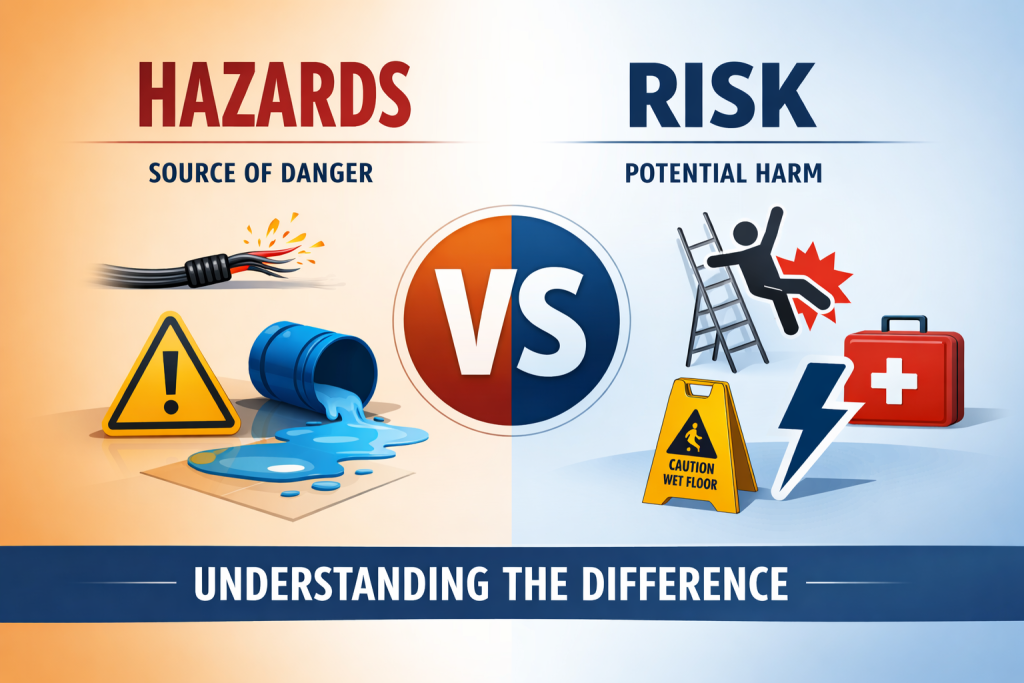
In health and safety, the terms hazard and risk are often used interchangeably.
However, they do not mean the same thing.
Understanding the difference is essential — especially for small and medium business owners who are responsible for compiling safety files, conducting risk assessments, and protecting their employees on site.
Let’s break it down clearly and correctly.
What Is a Hazard?
A hazard is anything that has the potential to cause harm.
It is the source of danger.
The hazard itself is not the injury — it is the condition, object, or activity that could lead to injury.
Common Workplace Hazards:
- Exposed electrical cables
- Wet or slippery floors
- Moving machinery
- Working at heights
- Hot surfaces or molten materials
- Chemicals and hazardous substances
- Manual handling of heavy loads
A hazard exists whether or not someone has already been injured. It simply has the potential to cause harm.
What Is a Risk?
A risk is the harm or injury that could result from exposure to a hazard.
In simple terms:
The hazard is the cause.
The risk is the possible injury or damage that could occur because of it.
Practical Examples
Electrical Cable
- Hazard: Exposed electrical cable
- Risk: Electric shock or electrocution
Wet Floor
- Hazard: Wet floor
- Risk: Slipping and sustaining fractures or soft tissue injuries
Working at Heights
- Hazard: Working on a ladder or scaffold
- Risk: Falling and suffering serious injury or fatality
The hazard is what creates the danger.
The risk is the injury that could happen if that hazard is not properly controlled.
Where Do Likelihood and Severity Fit In?
Once the hazard and risk have been identified, the next step is to assess:
- Likelihood – How likely is it that the injury will occur?
- Severity – How serious would the injury be if it did occur?
These two factors determine the risk rating.
The correct process for a risk assessment is therefore:
- Identify the hazard
- Identify the risk (the potential harm)
- Evaluate likelihood
- Evaluate severity
- Implement control measures
Many businesses confuse the definition of “risk” with the risk rating itself. It is important to understand that the risk is the injury or harm — while likelihood and severity are tools used to measure how serious that risk is.
Why This Matters for Small and Medium Businesses
Compliance requirements apply to the nature of the work being performed — not the size of the company.
Even if you are conducting a small repair, such as replacing a bolt, the environment in which you are working determines the hazards and risks involved.
Failure to properly identify and control risks can result in:
- Workplace injuries
- Production delays
- Increased compensation fund costs
- Rejected safety files
- Insurance complications
- Legal consequences
A proper understanding of hazards and risks is not about paperwork — it is about preventing avoidable harm and protecting your business from unnecessary financial and legal exposure.
In Summary
- Hazard = The source of potential harm.
- Risk = The injury or damage that could result from that hazard.
- Likelihood and Severity = The measurement tools used to determine the risk rating.
When business owners understand this distinction clearly, risk assessments become far more practical, accurate, and effective.
A well-structured safety system begins with identifying hazards correctly and understanding the risks they present.
That is the foundation of effective health and safety management.